About VR-Dreamer
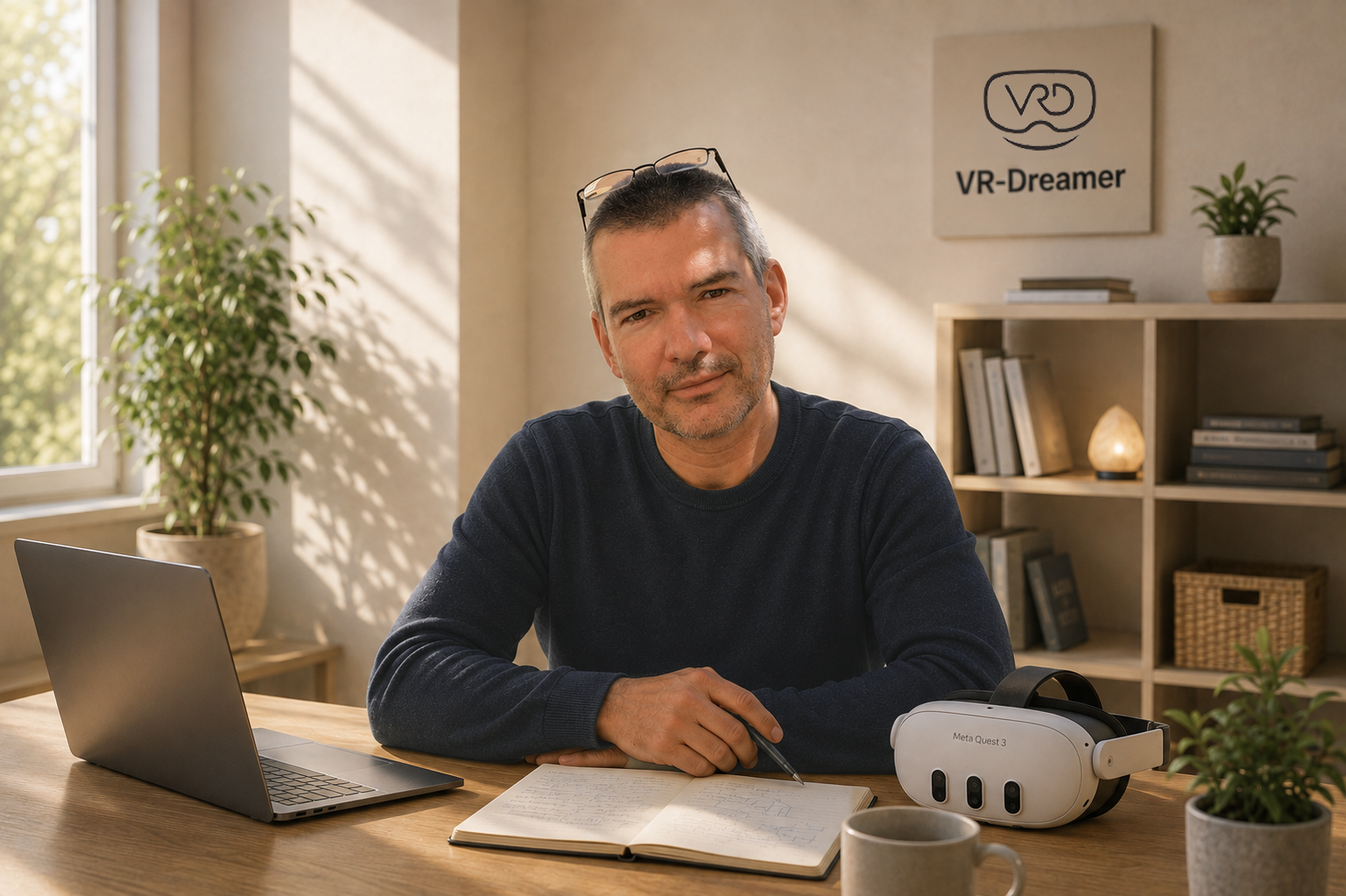
Our story
From a personal experience to VR-Dreamer
VR-Dreamer did not begin as a technology project. It grew out of a personal experience and out of regular, hands-on work with people.
The first impulse was the wish to open up new experiences for my mother – at a time when travel or discovering new places was no longer possible for her. Virtual reality allowed her to experience new environments, new situations, and new emotions again – in a way that had not been accessible before.
Later, I began working in social care institutions in Switzerland. There I became aware that it is not only seniors who experience such limitations, but also people with physical, cognitive, or psychological impairments. For many of them, their state of health or the environment of the institution itself considerably restricts their possibilities for movement, new experiences, independence, or social contact.
The first experiences showed that virtual reality can make new experiences and new places accessible. Gradually, however, something much more important emerged: it does not simply have to transport a person into another world. It can add new possibilities, new interactions, and new forms of experience to their own, real world.
It is precisely out of these everyday observations that VR-Dreamer emerged – not as a technological experiment, but as a practical tool that can help meet the challenges of everyday life.
We develop and deploy digital applications to help manage health-related, psychological and social challenges of everyday life.
About me
Psychology, practice, and the development of VR-Dreamer
I studied psychology with a focus on social psychology. For around twenty years, I worked in marketing research and the study of human behavior. Over time, however, I felt the need to bring my experience into work that has a direct impact on the everyday lives of real people.
After moving to Switzerland, my psychology degree was officially recognized in November 2022. I then began working in social care institutions – where my first practical experience using virtual reality with seniors and people with health impairments took shape.
The first experiments took place at Frienisberg – üses Dorf, and were later continued at Stiftung Aarhus. Today, such approaches are, for example, regularly continued and further developed through guided VR sessions at Seelandheim. Many of our applications and concepts arise from observations and conversations made in practice.
Today, VR-Dreamer is dedicated to developing digital solutions that help address the health-related, psychological, and social challenges of everyday life.
Timeline
Key milestones of VR-Dreamer
1999
- Master's degree in psychology with a focus on social psychology from the Faculty of Arts at Comenius University Bratislava, Slovakia.
1999 – approx. 2021
- Around twenty years of professional practice in market research, behavioral research, and applied social psychology.
November 2022
- Official recognition of the psychology degree in Switzerland.
2023–2025
- First practical experience, and an increasingly systematic use of virtual reality, in working with residents of Frienisberg – üses Dorf, Seedorf BE.
- During this period, the first observations emerge on how virtual reality can enable new experiences, support emotional experience, and expand the possibilities of people with health-related or cognitive limitations.
2025 – early 2026
- Continuation of practical work with virtual reality at Stiftung Aarhus, Gümligen BE, including discussions with the physiotherapy department about motivation for repeated movements and exercises.
- 2025: Founding of the company Marek Prochocky VR-Dreamer.
- The experience at Frienisberg – üses Dorf was part of a project connected to Innosuisse.
Since February 2026
- Regular guided VR sessions at Seelandheim, Worben BE.
- The observations from this regular practice become the direct basis for the development of Dreamer Bubbles and the shaping of the Pastel Ball concept.
2026
- Development of Dreamer Bubbles.
- Elaboration of the concepts for Pastel Ball, Dreamer Physio, and Dreamer Sense.
- Preparation of a scientific validation together with the IAF Institute for Ageing Research at OST – Eastern Switzerland University of Applied Sciences (IAF Institut für Altersforschung der OST – Ostschweizer Fachhochschule) in St. Gallen. The originally more broadly conceived approach to investigating guided VR for people with support needs was, in the course of further exchange, focused on Pastel Ball and people with dementia.
Collaboration & Experience
VR-Dreamer has collaborated, gained practical experience, run demonstrations, or held professional and research-oriented discussions with organisations from care, social services, psychiatry, research and innovation.
Seelandheim, Worben BE
Frienisberg – üses Dorf, Seedorf BE
Stiftung Aarhus, Gümligen BE
Psychiatriezentrum Münsingen
IAF Institut für Altersforschung der OST – Ostschweizer Fachhochschule, St. Gallen
Innosuisse
Contact Marek Prochocky
Questions, ideas, or an initial conversation – feel free to reach out directly or via the contact form.
Get in touch