
Pastel Ball
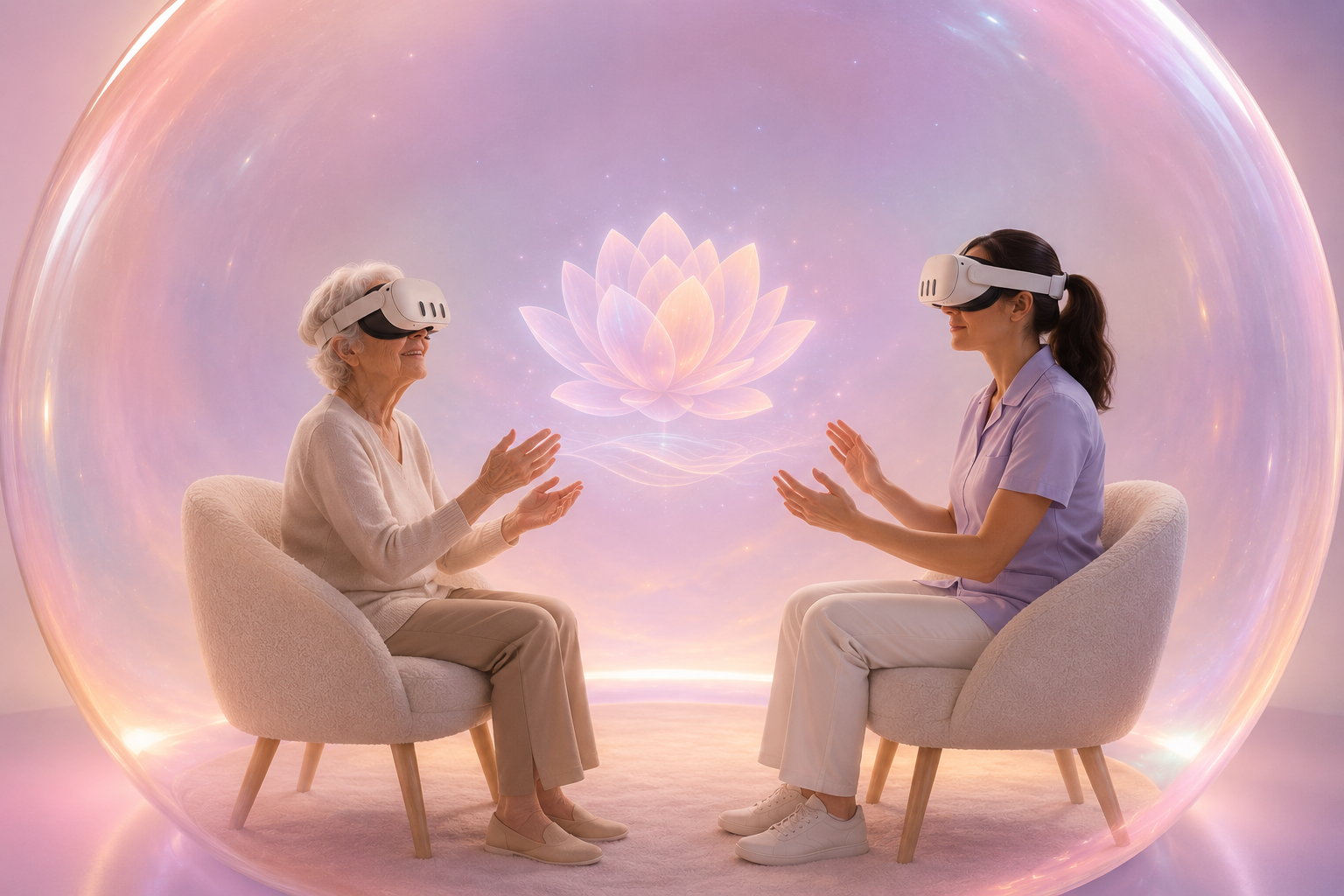
Pastel Ball is a large pastel-colored sphere that filters the visual and acoustic stimuli of the surroundings. The therapy professional and the user can be present together in the same shared space. Pastel Ball is not a movement application.
Target group and challenge
Pastel Ball is aimed primarily at people living with dementia. Emotional distress is one of the greatest, and so far under-supported, needs in dementia care.
Possible difficulties include restlessness, anxiety, emotional distress, apathy, confusion, sensory overload – not every person with dementia experiences these states in the same way or with the same intensity.
When emotional distress increases, this can make communication more difficult, increase resistance to care actions, and impair quality of life.
Why Pastel Ball?
Pastel Ball is designed as a guided platform for emotional regulation. Pastel Ball creates a protected, controllable virtual space in which a guiding professional can specifically adapt the environment and individual stimuli to the desired emotional state.
Depending on the goal, this is intended to enable calming, reduction of overstimulation, emotional balance, activation, engagement, reminiscence work and meaningful conversations. The assumption is that a deliberately reduced, person-centered environment can support emotional regulation – no proven clinical effect is promised; the actual effect is to be scientifically investigated.
How does it work?
Pastel Ball uses two connected headsets. The guiding professional controls the session, selects the goal, and continuously adapts the environment and virtual elements. The person with dementia experiences a simple, fully guided environment in the process – without menus and without needing to operate any technology themselves.
The environment can be adjusted through color, brightness, and visual complexity, as well as ambient sound and music. In addition, a single, carefully selected virtual element can be introduced – its appearance, movement, and interaction are chosen according to the emotional goal.
For this, the system can make use of, among other things, music, ambient sound, a selected visual object, content related to personal memories, calming or activating elements. An unlimited number of elements is deliberately not shown at the same time – the focus is on reducing competing stimuli.
Principle of action, as a concept
Pastel Ball translates principles of stimulus-reduced, person-centered support into a controllable virtual space. Fewer competing stimuli and a deliberately selected visual or acoustic focus are intended to support emotional regulation. The actual effect is to be investigated as part of a scientific validation.
Figures and context for Switzerland
≈160'000
people currently live with dementia in Switzerland
≈35'000
new diagnoses per year
2050
a marked further increase in the number of people with dementia is expected
Source: Federal Office of Public Health (FOPH), 2025
Status and validation
The concept emerged from regular, hands-on VR work in Swiss care institutions. The next steps are building an MVP and carrying out a systematic validation. The scientific focus has been concentrated on Pastel Ball and people with dementia.