Dreamer Physio
Dreamer Physio is a tool for physiotherapists and clinics. It can guide a person through exercises both at the institution and at home.
A tool for physiotherapists
Dreamer Physio is intended to support physiotherapists in extending their individually planned treatment into patients' homes between appointments.
Dreamer Physio does not replace a physiotherapist. It is intended to support their individually planned treatment and continue it between appointments.
The challenge at home
Without guidance, patients often perform prescribed exercises at home less often than intended, repeat them imprecisely, and lose motivation through repetition. Both immediate feedback and objective information for the physiotherapist between appointments are lacking.
Depending on the context, studies report non-adherence to home exercise programs of up to around 50 percent.
Source: Argent et al., JMIR mHealth and uHealth, 2018
Origin of the idea
The first impulses arose from conversations with the physiotherapy department of Stiftung Aarhus in Gümligen. The central question was above all how repetitive exercises could be made more motivating. Regular guided VR sessions at Seelandheim in Worben subsequently showed how naturally people repeat movements when these become part of a meaningful and enjoyable activity. From this came the idea of making this principle usable between physiotherapy appointments as well.
How could Dreamer Physio work?
- 1
The physiotherapist demonstrates the individually prescribed exercise and records it.
- 2
The exercise is assigned to the respective patient.
- 3
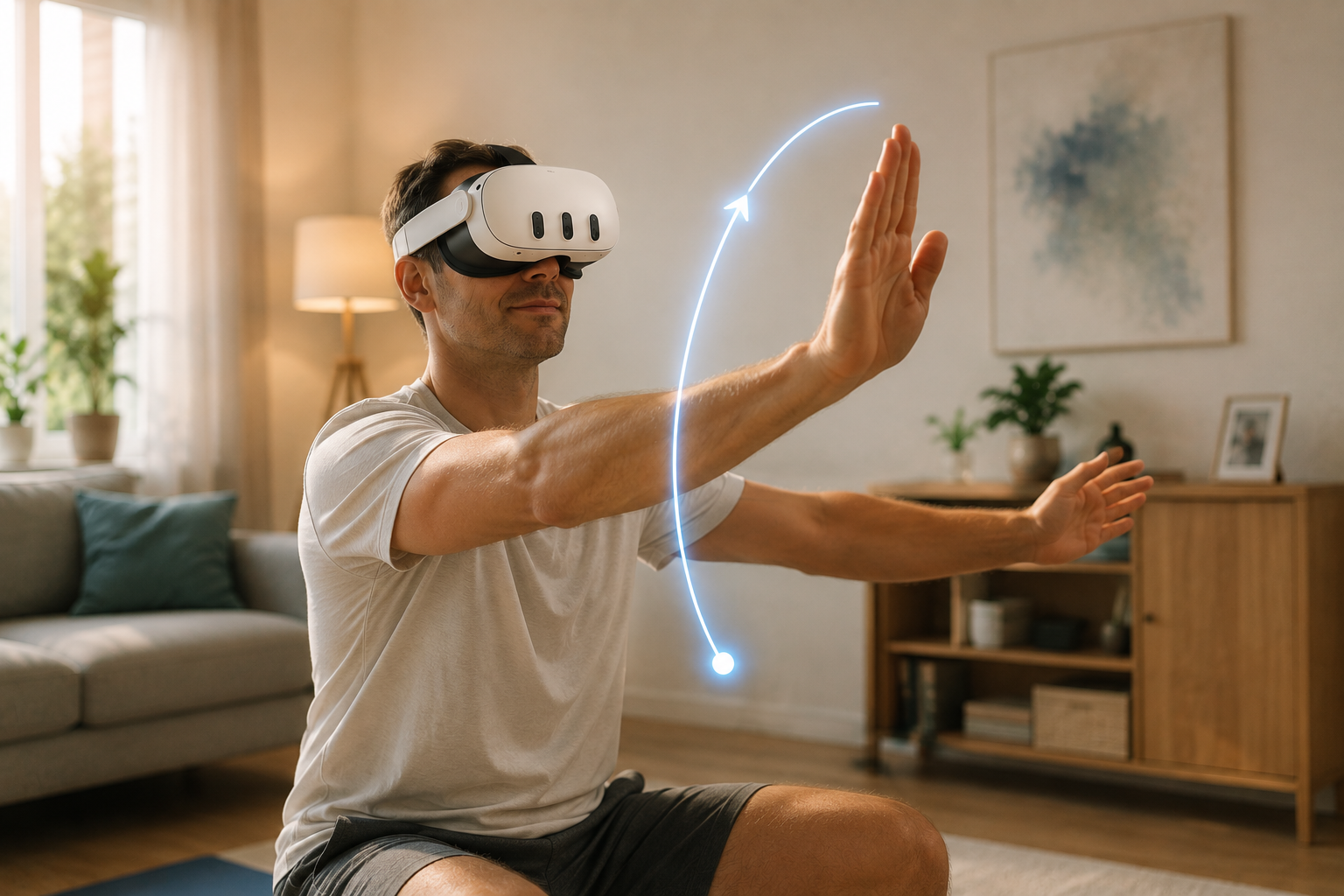
The exercise is repeated at home in mixed reality.
- 4
A simple guide line and a target point show the direction and extent of the movement.
- 5
The system can capture relevant movement data in the process.
- 6
Before the next appointment, the physiotherapist receives a clear summary.
Possible captured parameters include, among others, movement path, tempo, range of motion, repetitions, exercise sequence. Not every one of these parameters has already been implemented – much of this is planned at the concept stage and is to be realized step by step.
Motivation
The goal is not gamification for its own sake. Movements in the virtual or mixed space can generate calm, meaningful feedback, so that the repetition feels meaningful and motivating rather than purely mechanical.
Mixed reality
Dreamer Physio deliberately relies on mixed reality rather than fully virtual environments: the patient continues to see the real room, real exercise equipment can remain visible, and only a simple virtual guidance layer is added. The operation is deliberately kept simple.
Feedback for the therapy professional
A clear summary for the therapy professional is planned: whether sessions were carried out, how often exercises were done, selected movement parameters, and possible recurring difficulties. Such a dashboard is currently at the conceptual planning stage and has not yet been implemented.